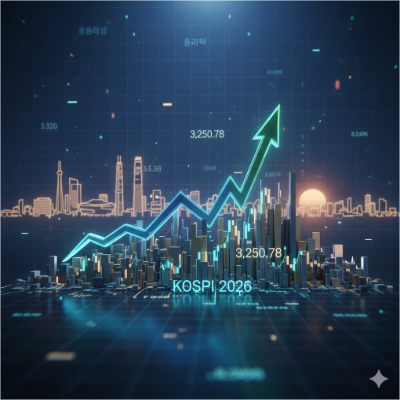
At last, the KOSPI 5,000 era has arrived. This milestone represents far more than a symbolic number—it signals a new leap forward for the Korean economy and capital markets. Long overshadowed by the so-called “Korea Discount,” Korean companies are finally being recognized for their true value in the global market. In particular, industry leaders such as Samsung Electronics and SK Hynix are spearheading this new era by dominating the AI semiconductor market.
However, the KOSPI 5,000 era does not guarantee a future filled only with optimism. Investment always comes with risk. To invest wisely in this new phase, it is essential to accurately analyze market conditions and establish a well-defined personal investment strategy.
Background and Significance of the KOSPI 5,000 Era
The KOSPI 5,000 milestone marks a structural upgrade of Korea’s economy and equity market, rather than a mere numerical achievement. For decades, the Korean stock market suffered from the persistent stigma of the “Korea Discount.” Today, that narrative is beginning to change.
This rally is not simply the result of excess liquidity. It is driven by substantial earnings growth, particularly from Korean companies leading the global AI semiconductor boom, such as Samsung Electronics and SK Hynix. The market now resembles a high-performance engine accelerating smoothly on an open highway.
Government-led value-up initiatives have also played a critical role. Corporate governance reforms, amendments to commercial law, and strengthened shareholder return policies have restored confidence among foreign investors, encouraging long-term capital inflows. Additionally, expectations of interest rate cuts have prompted capital previously tied up in bank deposits and real estate to flow into equities.
Structural Changes in the Korean Stock Market
The KOSPI 5,000 era highlights fundamental changes in Korea’s capital market structure. Improved corporate governance has significantly reduced practices that once disregarded shareholder interests. Companies are now actively increasing dividends and shareholder returns, enhancing overall market credibility.
Foreign investors who once viewed Korean equities as volatile emerging-market assets are increasingly reclassifying them as growth stocks with characteristics of developed markets. Transparent accounting standards, improved governance, and globally competitive technologies—especially in semiconductors—have reshaped perceptions.
As AI becomes indispensable across industries, Korea has emerged as a critical hub in the global semiconductor supply chain. These structural shifts have accelerated foreign capital inflows and laid a solid foundation for the KOSPI 5,000 era.
Dividend Income Separate Taxation and Tax Incentives
The introduction of separate taxation for dividend income is adding a new dimension to investment strategies in the KOSPI 5,000 era. Previously, financial income exceeding KRW 20 million was subject to a maximum tax rate of 45%, significantly reducing the appeal of dividend investing.
Under the new framework, investors in qualifying companies can benefit from reduced tax rates. Eligible firms include those with a dividend payout ratio of at least 40%, or those with a payout ratio of 25% or higher and dividend growth exceeding 10% year-over-year. Companies such as Samsung Electronics, Hyundai Motor, Kia, and various holding companies are expected to meet these criteria.
If fully implemented, dividend tax rates could be reduced to 30% for major shareholders and 25% for general investors, further stimulating investment demand. Additionally, the National Pension Service plans to increase its domestic equity allocation from 17% to 20%, potentially injecting nearly KRW 30 trillion into the stock market.
Transformation Toward Web3 Finance and Investment Outlook
Naver is emerging as a potential powerhouse in Web3 finance. Through a proposed merger between Naver Financial and Dunamu, Naver aims to evolve beyond a traditional IT company into a global Web3-based financial infrastructure provider.
Dunamu demonstrated exceptional profitability, recording operating profits of KRW 784.4 billion in 2023 alone. If the merger is completed, Naver’s consolidated operating profit could jump from KRW 3 trillion to KRW 4 trillion.
Over the next five years, Naver plans to invest KRW 10 trillion in AI and Web3 technologies. The integration of Naver Pay’s payment network with Dunamu’s blockchain capabilities could give rise to decentralized banking services. Although Web3 finance is still in its early stages, its growth potential presents compelling long-term investment opportunities.
2026 Investment Environment Outlook and Risk Factors
Looking ahead to 2026, the investment environment in the KOSPI 5,000 era is expected to remain favorable in the first half of the year, supported by a semiconductor upcycle and continued government policy support. Major securities firms forecast the KOSPI reaching between 5,500 and 6,000, while aggregate operating profits of listed companies could exceed KRW 500 trillion for the first time.
Beyond semiconductors, sectors where Korea holds a competitive edge—such as defense, shipbuilding, nuclear power, and biotechnology—may lead sector rotation rallies.
However, caution is warranted in the second half of the year. Concerns over AI investment efficiency, potential interest rate pressures, and profit-taking by retail investors could introduce volatility. While 5,000 may serve as a new support level, partial profit realization around the 5,500–5,800 range may be prudent. Additionally, elevated KRW/USD exchange rates could weigh on overseas consumption.
Sector-Specific Investment Ideas
Which sectors deserve attention in the KOSPI 5,000 era? Let’s focus on petrochemicals and power infrastructure.
The petrochemical industry is showing signs of recovery, driven by reduced Chinese supply, U.S. tax incentives, and stabilizing oil prices. Companies such as Lotte Chemical, LG Chem, and Kumho Petrochemical are expected to benefit as margins improve under these favorable conditions.
Meanwhile, the rapid expansion of AI data centers is boosting demand for power infrastructure. Data centers consume massive amounts of electricity, making stable power supply essential. Companies like Hyundai Electric, LS Electric, and Samsung SDS stand out as potential beneficiaries.
Investment Strategies for the KOSPI 5,000 Era
How should investors navigate the KOSPI 5,000 era? Rather than relying on optimism alone, disciplined strategies are essential.
Diversification is paramount. Allocating capital across multiple sectors and asset classes helps mitigate heightened volatility. A long-term investment horizon is equally important—focusing on fundamentally strong, undervalued companies rather than reacting to short-term market fluctuations.
Dollar-cost averaging through regular monthly investments can also be effective, particularly in uncertain markets, by lowering average purchase prices over time.
Conclusion
The KOSPI 5,000 era presents both unprecedented opportunities and meaningful risks. By carefully balancing optimism with caution and establishing a clear investment strategy grounded in diversification, long-term thinking, and value investing, investors can position themselves for sustainable success. Navigating the waves of the KOSPI 5,000 era wisely may ultimately lead to a more prosperous financial future.
What does the KOSPI 5,000 era mean?
The KOSPI 5,000 era signifies that South Korea’s economy and stock market have advanced to a higher level, offering an opportunity to break away from the long-standing image of the “Korea Discount.”
Which investment sectors should investors focus on in the KOSPI 5,000 era?
Petrochemical and power infrastructure companies appear promising, with particular attention warranted for power infrastructure firms benefiting from the growing construction of AI data centers.
How does separate taxation of dividend income affect investment decisions?
Separate taxation of dividend income reduces the tax burden for investors who invest in companies that meet certain criteria, enhancing the attractiveness of dividends and potentially stimulating investment demand from foreign investors and high-net-worth individuals.
What opportunities does Web3 finance offer to investors?
The Web3 finance market is still in its early stages but holds enormous growth potential, and cases such as the merger between Naver and Dunamu could offer attractive investment opportunities for investors.
What should investors be cautious about when investing in the KOSPI 5,000 era?
In the KOSPI 5,000 era, market volatility may increase, making it important to manage risk through diversified investment, long-term investing, and value-based strategies, while making investment decisions based on careful and thorough market analysis.