The tech world is buzzing with anticipation. In 2026, the smartphone market will witness its biggest clash yet: Samsung Electronics vs Apple. With both giants preparing their most advanced devices ever, the question on everyone’s mind is: Who will claim the throne?
Especially, the Samsung Galaxy S26 vs iPhone 17 battle is drawing global attention. Can Samsung’s hardware innovation outshine Apple’s ecosystem? Today, we dive deep into the rumors, leaked specs, and technological breakthroughs to predict the winner of the 2026 smartphone war.
1. Design & Display: The Quest for Perfection
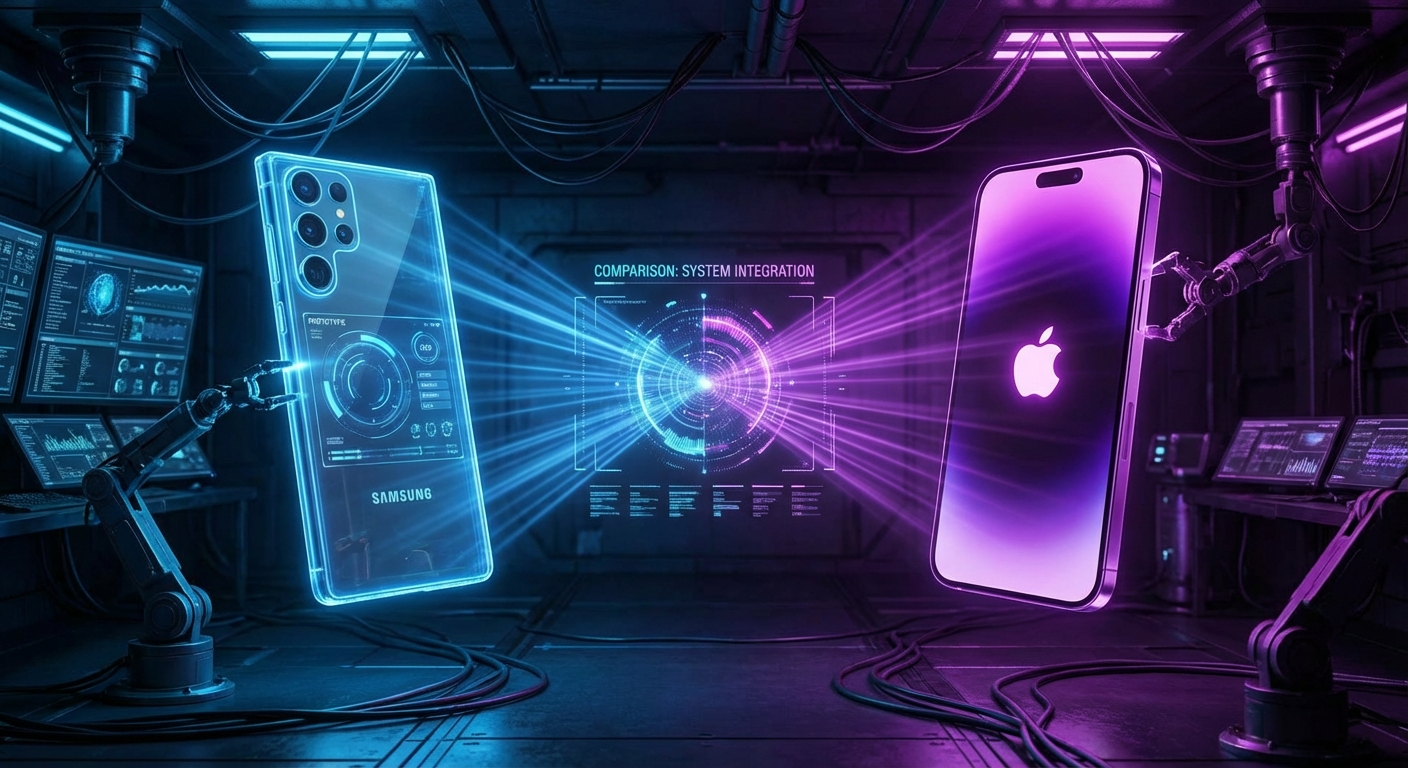
The Samsung Galaxy S26 is rumored to achieve the ‘Zero Bezel’ dream. By utilizing next-gen OLED technology, Samsung aims to deliver a true full-screen experience that immerses users like never before. In contrast, the iPhone 17 is expected to refine its Dynamic Island, but Samsung’s bold move towards a seamless display gives it a visual edge.
Moreover, Samsung’s mastery of materials—specifically the new titanium alloy frame—promises a device that is both lighter and more durable than its predecessors.
2. Performance: Exynos vs A19
The heart of the battle lies in the processor. Samsung’s proprietary ‘Exynos’ chip has made massive strides, aiming to rival Qualcomm’s Snapdragon and Apple’s A-series chips. The focus for the S26 is ‘AI Performance’. The new NPU (Neural Processing Unit) is designed to handle complex on-device AI tasks instantly, without relying on the cloud.
While Apple’s A19 chip will undoubtedly be powerful, Samsung’s optimization of hardware for multitasking and gaming could offer a smoother real-world experience for power users.
3. AI Revolution: Samsung’s ‘Real’ Assistant
2026 is the year of the ‘AI Phone’. Samsung has already established itself as a pioneer with the Galaxy S24 series. The S26 will take this further, offering features like real-time call translation, advanced document summarization, and generative photo editing right out of the box.
Samsung’s open ecosystem strategy, collaborating with Google’s Gemini, provides users with a more flexible and powerful AI assistant compared to Apple’s closed ‘Apple Intelligence’. For users who want cutting-edge AI features today, Samsung Galaxy is the clear leader.
4. Camera: Reaching for the Stars
Samsung’s ‘Space Zoom’ is legendary. The S26 Ultra is expected to feature an upgraded 200MP sensor and AI-enhanced zoom that captures crystal-clear images even at 100x magnification. The ‘Nightography’ feature will also see significant improvements, allowing for stunning low-light photography.
While the iPhone 17 will excel in video recording, for pure photography enthusiasts who want to capture every detail from a distance, the Galaxy remains unrivaled.
Conclusion
The 2026 smartphone war is not just about specs; it’s about who offers the best AI experience. Samsung Galaxy S26 is positioning itself as the ultimate AI companion, pushing the boundaries of what a phone can do. While the iPhone 17 will be a formidable competitor, Samsung’s relentless innovation makes it the most exciting device to watch this year.
Related Posts (Korean)
Curious about the technology behind these phones? Check out our analysis of the AI semiconductor market.
When is the release date?
Samsung is expected to unveil the Galaxy S26 series in January or February 2026, while the iPhone 17 will likely launch in September 2026.
Which has better AI features?
Samsung leads in ‘On-Device AI’ with real-time translation and generative editing. Apple is catching up with ‘Apple Intelligence’, but Samsung’s open ecosystem offers more versatility.
Will the Galaxy S26 have a new design?
Rumors suggest a near ‘Zero-Bezel’ display and a refined titanium frame, offering a more futuristic look compared to the iPhone’s Dynamic Island.
What about the camera specs?
The S26 Ultra is rumored to feature a 200MP+ sensor with enhanced AI zoom capabilities, surpassing the iPhone 17 in long-range photography.
Is the price increasing?
Due to rising AP costs, a slight price hike ($50-$100) is possible, but Samsung may freeze prices to maintain competitiveness.